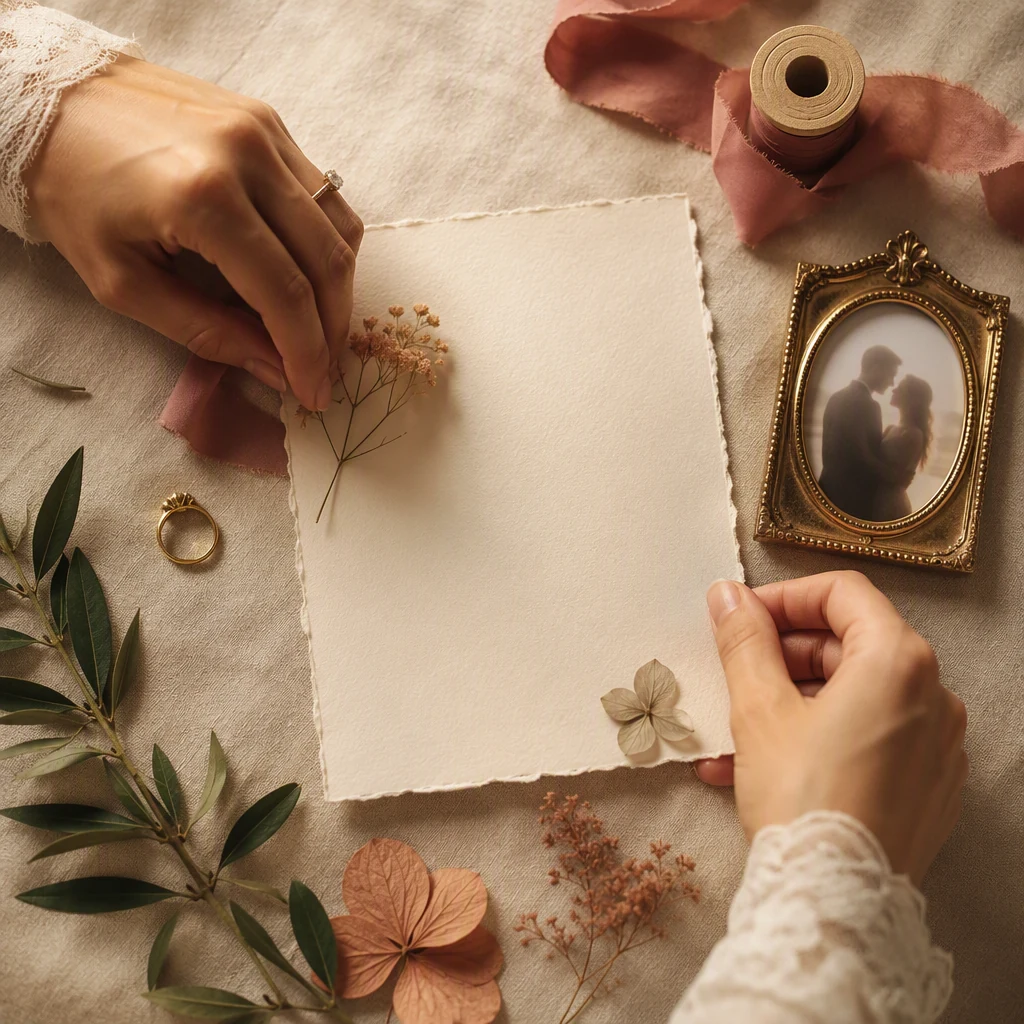
How to Make Your Wedding Invitation More Personal
Every wedding invitation says "please come to our wedding." But the invitations guests actually remember say something else — they say "this wedding is going to be wonderful, because the two people getting married are wonderful, and they made this just for us."
A personal invitation does not require a celebrity designer or a six-figure stationery budget. It requires thought: the right photo, the right words, the right details, and the courage to sound like yourself instead of like a wedding catalogue. This guide shows you exactly how to make your wedding invitation more personal — whether it is printed, digital, or a website link.
Why Personalisation Matters So Much
Consider what your guests experience when they receive an invitation. It is the first moment of your wedding they get to participate in. A generic invitation says "this is one of hundreds of weddings this year." A personal invitation says "this is our wedding, and we thought about you when we made it."
Personalisation also does practical work: it sets the tone for the entire celebration. Guests who smile at the invitation arrive in a good mood. Guests who read a personal note feel closer to you before the ceremony even starts. And years later, the invitation is what they kept — so make it worth keeping.
1. Start With a Photo That Tells the Truth
The fastest way to make an invitation personal is the right photograph. Not just any photo of the two of you — a photo that carries your actual relationship:
- The engagement photo with real laughter, not a stiff pose.
- The candid from your favourite holiday — the one where you are both covered in sand and grinning.
- The ordinary moment — cooking together, walking somewhere, arguing over a takeaway menu.
The photo sets the emotional temperature. A formal portrait says "elegant wedding." A laughing candid says "joyful wedding." Choose the one that matches the day you are actually planning.
2. Write in Your Own Voice
The single most powerful personalisation tool costs nothing: your words. Most invitations are written in a formal, borrowed voice — "request the honour of your presence" — which is lovely for some weddings, but wrong for many.
Ask yourself: how would you actually tell your friends about this wedding? Then write that.
If you are playful:
> Look, you already know we're getting married — this is the official version. Join us on 14 March. Wear something you can dance in. RSVP so we can count you (and your plus-one).
If you are romantic:
> We met, we fell in love, and now we want to celebrate with the people who made us who we are. Please join us on 14 March.
If you are traditional:
> Together with their families, Sarah and James request the honour of your presence...
All three are valid. What is not valid is a voice that belongs to neither of you. If the wording would never come out of your mouths, change it.
3. Tell the Story in One Sentence
You do not need a full love story on the invitation itself — one memorable sentence does the job:
- "We met at a wedding we were both politely trying to skip."
- "Our first date lasted nine hours and we never once checked our phones."
- "It took us six years, three countries, and one very brave proposal."
That single line makes the invitation unmistakably yours. Nobody else has that sentence. (The full story, if you want it, belongs on your wedding website.)
4. Add an Inside Joke — Carefully
Inside jokes are the spice of personal invitations, but they need a wide enough audience. The test: if the joke lands only for three people, it belongs in the speech, not the invitation. If it lands for most of the guest list — or even just makes people smile at its absurdity — keep it.
Examples that travel well:
- "Dress code: whatever you'd wear to dinner with us. Which is to say, anything."
- "The ceremony is short. The party is not."
- "Gifts optional. Dancing mandatory."
The rule is warmth, not exclusion. If the joke could make someone feel like an outsider, cut it.
5. Personalise the Details, Not Just the Decor
Beyond the big-ticket personalisation, small thoughtful details multiply:
- The venue with a reason. Add one line about why you chose it: "the garden where James proposed" or "the hall where both our families celebrated."
- The date with meaning. If the date matters — anniversary of your first date, your grandparents' wedding day — say so.
- The meal with a memory. If the menu includes your first-date dish or your grandmother's recipe, mention it.
- The schedule with character. "4:00 p.m. Cake cutting (Sarah will cry)" is unforgettable.
These details turn logistics into stories.
6. Make It a Map of Your Life Together
If your invitation is digital or linked to a website, use maps as storytelling:
- Pin where you met, where you got engaged, and where you are marrying.
- Add a note under each pin: "Where everything started" / "Where we said yes" / "Where we say forever."
- For diaspora guests, add pins for the airport and recommended hotels.
It is practical and personal at the same time — and it gives distant guests a sense of your shared geography.
7. Custom Colours and Typography That Match You
Design choices are personalisation too. The colours and typography of your invitation should be your colours and your typography — the palette of your wedding, the style of your relationship.
- Colours: match your flowers, your decor, your culture. A wedding whose invitation, website, and venue all speak the same palette feels coherent and considered.
- Typography: a script font says romantic; a clean sans-serif says modern; a bold serif says confident. Choose what sounds like your relationship's accent.
- Consistency: use the same fonts and colours on your invitation, website, and printed stationery. The echo between them is the personalisation your guests notice without knowing why.
8. A Monogram or Motif That Only Means Something to You
A small monogram — your initials intertwined, or a motif drawn from your story — gives the invitation a signature. Ideas:
- A bird because you met at the bird market.
- A wave because you got engaged at the coast.
- A coffee cup because your first date was at a café.
The motif can appear on the invitation, the website, the menu cards, and the thank-you notes. It becomes the visual emblem of your wedding.
9. The Personal Letter (The Secret Weapon)
If you want the single most effective personalisation move, it is this: a short letter on the invitation page (or a small card in a printed suite) written to your guests as a group.
> To our people — thank you. Thank you for the flights, the time off, the babysitters, and the gift of simply being there. This day is about us, but it is made by you. We cannot wait to celebrate with you.
No design, no gimmick — just sincerity in your own words. This is the part guests remember longest, and it costs nothing but honesty.
10. Let Your Culture Speak
Personal does not have to mean modern — for many couples, the most personal thing they can do is honour their heritage:
- Traditional patterns, colours, or motifs in the design.
- A greeting in your language alongside English.
- A short explanation of the traditional ceremony's customs, so every guest can follow along.
- Attire guidance that helps guests participate comfortably.
An invitation that teaches your culture to your guests is deeply personal — it shares who you are and where you come from.
11. RSVP That Feels Like You
Even the RSVP can carry personality. The confirmation page is a chance for one more touch: "You're coming! We can't wait to see you. Any song requests? Tell us now."
Add fields that show you care about the details:
- A dietary preferences field — guests feel seen when you ask.
- A song request field — guests feel involved when you ask.
- A note field for messages — guests feel heard when you ask.
These small fields turn the RSVP from an administrative chore into an exchange between friends.
12. Choose the Right Format for Your Personal Touch
Some personalisation works better in certain formats:
- Video invitation: perfect for your voices, your laughter, and a tour of your story in thirty seconds.
- Interactive link invitation: perfect for maps, letters, RSVPs, and the full story on your wedding website.
- Printed card: perfect for texture, keepsakes, and a monogram that can be framed.
You are not limited to one. Many couples send a digital link to everyone and a printed keepsake card to the inner circle — getting the personal reach of digital and the personal warmth of paper.
How Platforms Help (Without Doing It For You)
You do not need to be a designer to execute any of this. Wedding platforms give you the mechanics — themes, editable colours and typography, Google Maps pins, RSVP forms with plus-ones and dietary preferences, dashboards — and you supply the personality. If you would rather not build it at all, services like My Joyfullday let you have your custom invitation or event website created for you, via WhatsApp or with Clara Web Studio, and you still make the personal choices: the words, the photos, the colours, the story.
The Personalisation Checklist
Before you call the invitation finished, check:
- Does the photo show us as we really are?
- Does the wording sound like us — or like a template?
- Is there one line that could only be ours?
- Do the colours and typography match our wedding?
- Is there a personal letter or note for our guests?
- Have we told guests why the venue and date matter?
- Does the RSVP feel like an invitation to participate, not a form to fill?
- Will a guest who knows nothing about us finish reading and feel they know us a little?
A Worked Example: One Couple's Personal Invitation
Here is how the ideas in this guide combine in practice. Njeri and Kip are getting married on the coast, where Kip proposed. Their invitation page does the following:
- The hero photo is a laughing candid from the engagement trip — sand, sunglasses, and genuine joy, not a stiff pose.
- The wording is theirs: "We said yes at the beach. Now we want to say it in front of you. Join us on 21 March 2026."
- One story line: "Our first date lasted six hours, and we finished each other's sentences by dessert."
- The colours are ocean blue and sand, echoing the venue and their wedding palette; the typography pairs a relaxed script with a clean body font.
- A small wave motif — because of the proposal — appears on the invitation, the website, and later the menu cards.
- The maps pin three places: where they met, where Kip proposed, and where they are marrying, each with a one-line caption.
- The RSVP page includes a note field, and the confirmation message reads: "You're coming! The waves are ready. Any song requests?"
None of this cost extra — it is all photos, words, and design choices. But a guest who opens that invitation knows exactly whose wedding it is, and why it will be wonderful. That is the whole art of personalisation.
Conclusion
Making your wedding invitation more personal is not about spending more — it is about deciding to be yourselves. Use a photo that tells the truth, write in your own voice, add one sentence only you could write, choose colours and typography that match your day, and finish with a sincere note to the people you love.
Whether your invitation is printed, digital, or a link to your wedding website, the principle is the same: guests can feel when an invitation was made with thought. That feeling is the whole point. It is the first gift of your wedding — and it costs nothing but attention.