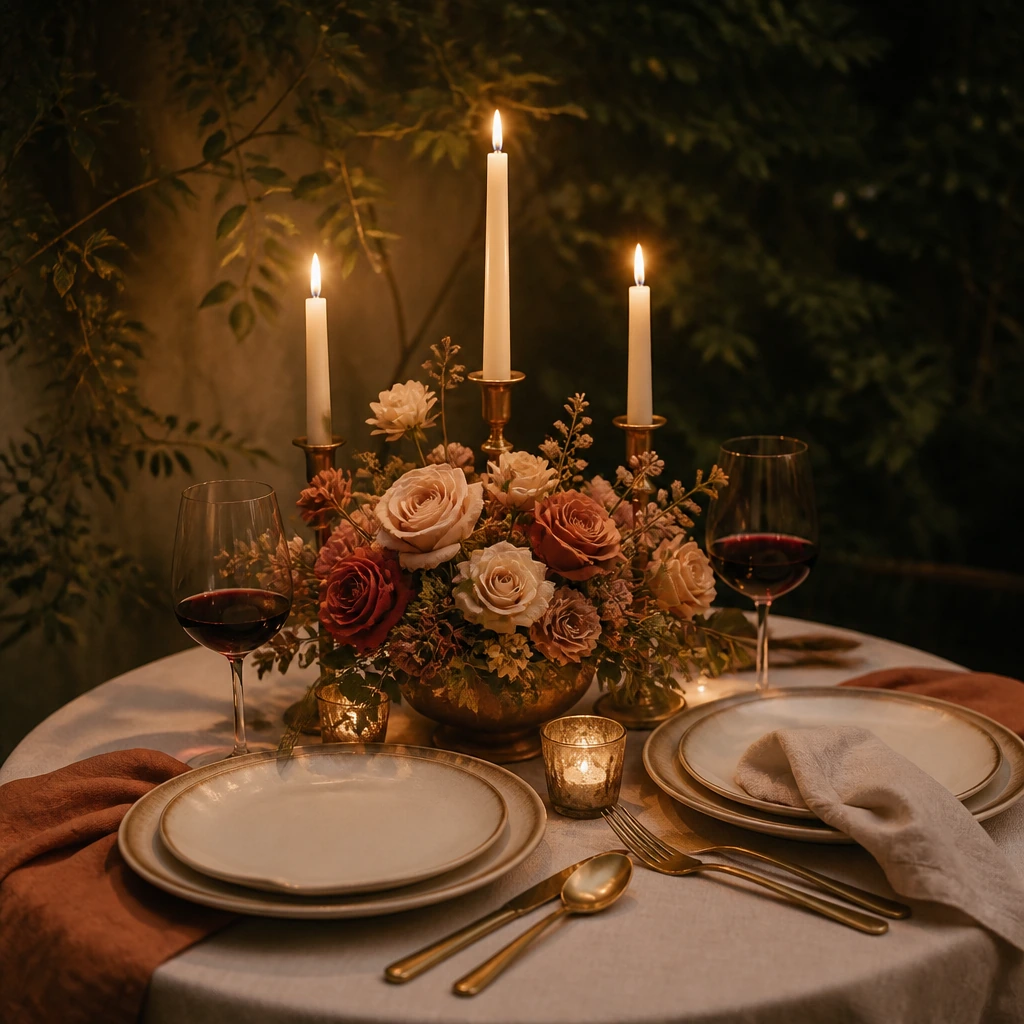
How to Plan a Romantic Dinner Invitation Online
A romantic dinner should feel like an event, not an errand. The difference is often the invitation: the way the evening is announced, framed, and anticipated. An online invitation turns a dinner date into an occasion before the first course is served — it sets the tone, builds the excitement, and gives the evening a shape. And it is easier to do beautifully than you might think.
This guide covers the full plan: designing the invitation, writing the details, handling the RSVP, coordinating the evening around it, and delivering the invitation itself in a way that lands.
Why an Online Invitation Works
An online dinner invitation is more than a text message with a time and place:
- It sets the tone. The design, colors, and wording tell your partner what kind of evening this is before it begins — casual and cozy, or dress-up and candles.
- It builds anticipation. An invitation that arrives a few days ahead turns the wait into part of the romance.
- It feels official. An RSVP page makes the dinner feel like a planned occasion, and the act of saying yes is itself charming.
- It is a keepsake. A beautifully made invitation page can be revisited — and if you keep it, it becomes part of your digital archive of each other.
- It coordinates the details. Dress code, time, location, menu teasers, and any surprises can live in one place.
Step 1: Define the Evening First
Before designing the invitation, decide what the dinner actually is. Answer these questions:
- What is the occasion? An anniversary, a birthday, a proposal, a "no reason at all" date? The occasion sets the register.
- What is the setting? At home (cooked by you, ordered in, catered) or at a restaurant (a favorite, a new spot, the place where you met)?
- What is the mood? Candlelit and formal, playful and casual, nostalgic (recreating a first date), or adventurous (a cuisine neither of you has tried)?
- What is the surprise, if any? A letter read after dessert, a gift, a playlist, a bigger announcement?
Write one sentence that captures the evening: "A candlelit dinner at home, recreating our first date, with a letter at the end." Every element of the invitation should serve that sentence.
Step 2: Design the Invitation Page
The invitation page is the front door of the evening. Design it with intention:
- Pick a theme and palette that match the evening. Warm and intimate — deep tones, candlelight colors, soft textures — for a romantic dinner. Playful and bright for a fun date night. Nostalgic for a recreation of your first date.
- Choose typography with character. An elegant serif for the headline, a clean readable face for the details. The typography should whisper "this is special" without shouting.
- Lead with the one line that matters. The top of the page should carry the invitation itself: "I would like to take you to dinner. Saturday, 7 p.m. Dress: your favorite dress. Place: our kitchen, candlelit."
- Include a photo — of the two of you, of the restaurant, of the dish you plan to cook, of the place where you first ate together. One image sets more tone than a paragraph.
- Keep the details organized. Date, time, location (or "revealed below"), dress code, and a note on what to expect — all in one scannable block.
Match the design to your partner. A partner who loves vintage will melt over aged-paper warmth; one who loves clean minimalism will respond to crisp whites and a single accent color. The invitation should feel like it was made for the person receiving it.
Step 3: Write the Details With Care
The words of an invitation do real work. Write them like you talk, with the occasion in mind:
- The headline — the invitation itself, in one warm sentence. "Saturday belongs to us."
- The what — what kind of evening: "A candlelit dinner for two, cooked slowly and served with the good plates."
- The why — the occasion, lightly: "Because it has been exactly one year since we burned the pasta together, and it seems we should celebrate."
- The where — the place, the address, or a gentle mystery: "Our kitchen. Wear something that makes you feel like the best version of you."
- The when — the date, the time, and the arrival note: "Arrive hungry at 7. Doors open at 6:45."
- The dress code — one line that sets the register: "Anything from 'I look incredible' to 'the hoodie I love.'"
- The menu tease — one or two lines that make mouths water without giving everything away: "Starter: the olives you ate all of on our first date. Main: your favorite, my secret recipe. Dessert: a surprise."
- The small print — any practical notes: parking, allergies, the time the evening ends, the fact that phones will be politely banished.
Keep the tone consistent throughout. If the dinner is funny and casual, keep the invitation funny and casual; if it is candlelit and serious, keep it warm and direct. The invitation is a promise about the evening, so it should be honest about what is coming.
Step 4: Add the RSVP
The RSVP is where the invitation becomes an event. Design it simply:
- A clear yes option — "I will be there" — with a confirmation message that appears after: "The kitchen has been notified. Bring your appetite."
- A playful maybe/no option — with an affectionate fallback: "You are contractually obligated to say yes to this one."
- A note field — if the dinner involves dietary preferences or practical details your partner should share.
- A countdown after the RSVP — once they say yes, the page can show the hours until dinner, building the anticipation.
The RSVP moment is part of the romance: your partner gets to officially accept the date, and the page can respond with delight. Make the confirmation feel like the beginning of the evening.
Step 5: Coordinate the Evening Around the Invitation
The invitation is the opening act; the dinner is the main event. Plan them together:
- If the dinner is at home: shop and prep ahead so the cooking happens before the arrival, or while the first course is being enjoyed. Set the table the way the invitation promised — the good plates, the candles, the playlist, the details.
- If the dinner is out: make the reservation early, confirm the timing, and tell the restaurant it is a special occasion (without spoiling the surprise, if there is one).
- Plan the transitions: a welcome drink, the first course, the pause for the letter or gift, dessert, and the after — coffee, a walk, a movie.
- Match the reality to the invitation: if the invitation promised candlelight and the good plates, deliver candlelight and the good plates. The invitation sets expectations; the evening should exceed them.
Step 6: Deliver the Invitation
The way the invitation arrives is part of its power. Options:
- A few days ahead: send the link with one line — "I have something planned for Saturday. Details inside." The wait builds anticipation.
- As a physical card: print the invitation or write the URL on a card, and hand it over — the physical object anchors the digital page.
- With a small preview: send a teaser image or line first, then the full invitation hours later.
- At the end of a normal date: as you say goodbye, hand over the invitation for the next one. The promise of more is part of the romance.
Privacy and Practicality
- If the page includes your address or other private details, protect it with a password, or keep the address off the page and reveal it in the confirmation message.
- Test the page on your partner's phone before sending.
- If the RSVP requires a response, make sure the confirmation arrives somewhere you will see it — the page, an email, a text.
Three Dinner Concepts and Their Invitations
The fastest way to design a great invitation is to start from a concept with a clear personality. Three that work almost every time:
- The first-date recreation. The invitation promises the past: "Same restaurant, same menu (almost), same two people — one year later." The page leans nostalgic: a photo from the original night, warm aged colors, the original date mentioned like a footnote.
- The at-home candlelit dinner. The invitation promises a private world: "Our kitchen, candlelit, the good plates, and a menu I refuse to reveal." The page is intimate: deep tones, soft typography, the address hidden behind the RSVP.
- The adventure dinner. The invitation promises the unfamiliar: "A cuisine neither of us has tried, at a table we have never sat at." The page is playful: bright colors, a teasing menu of unknowns, a dress code of "curious."
Pick the concept first, then let every design and copy decision fall out of it. An invitation built from a clear concept writes itself; an invitation built from a blank page is where invitations go to become generic.
The Day-by-Day Plan
A dinner invitation should arrive with time to build anticipation, and the evening should arrive fully planned. A week that works:
- Seven days out: send the invitation. One line in the message: "I have something planned for Saturday. Details inside."
- Five days out: confirm the logistics — the reservation or the groceries, the playlist, the good plates, any surprise.
- Three days out: send a tiny teaser — a single photo, a single line ("the menu involves your favorite thing, in a form you have not tried").
- One day out: prep everything that can be prepped. Set the table the night before if you can.
- The day of: the RSVP closes, the countdown hits zero, and the evening starts on time. The invitation promised a beginning; deliver it.
The plan does two things at once: it builds anticipation in your partner, and it forces you to finish the logistics early instead of the afternoon of the dinner.
When You Are Not a Cook
A romantic dinner does not require you to be a chef — it requires you to be a host. If cooking is not your strength, choose your version of the evening:
- The upgraded takeaway. Order from the place you both love, transfer the food to the good plates, light the candles, and let the playlist do the rest. The invitation can even joke about it: "Menu: our favorite delivery, served on plates that have never seen delivery."
- The catered table. A prepared meal from a local deli or catering counter, arranged on platters and served in courses. You are the host and the sommelier, not the cook.
- The restaurant reservation. The invitation becomes the reservation's frame: the page holds the dress code, the time, and the toast you will give. The restaurant cooks; you create the moment.
- The picnic alternative. If the kitchen is not the stage, move the dinner outdoors — a park, a rooftop, the place you met. The invitation promises a place instead of a menu.
The romance lives in the setting, the attention, and the words — none of which require culinary training. Cook if you love it; host if you do not.
How Joyfullday Supports a Dinner Invitation
An online dinner invitation is exactly the kind of event page Joyfullday supports: you can design an invitation with the right theme, colors, and typography for the evening, include the details and menu teasers, and add an RSVP so the dinner feels like the occasion it is. If the dinner is part of a bigger story — an anniversary, a proposal, a birthday — the invitation can sit alongside a digital love letter, a memory timeline, and a password-protected memory vault that keeps the whole celebration private. You bring the menu and the meaning; the page handles the ceremony.
Common Mistakes to Avoid
- Overselling the evening. The invitation should promise what the dinner will deliver; a mismatch is disappointing.
- Under-designing. A plain text link feels like a calendar entry. The design is the tone.
- Cluttered details. Date, time, place, dress, one tease — organized and scannable. If there are too many notes, the evening sounds like an instruction manual.
- Forgetting the RSVP. The yes moment is part of the romance; do not skip it.
- Ignoring mobile. The invitation will be opened on a phone. Test there.
- Skipping the follow-through. The invitation is a promise; the evening must keep it.
Final Thoughts
A romantic dinner invitation online is a small ceremony that makes a meal into a memory. Design it like the evening deserves, write it like you talk, and let the RSVP be the beginning of the occasion. Then cook the food, light the candles, and keep every promise the page made. The invitation is the first course; the evening is the rest. Plan both, and the dinner becomes the story you will both retell.